Your GP record moves with you when you change practice and is kept throughout your life. After a patient dies, GP records are kept for 10 years.
NHS records are not kept forever. Each kind of record has a minimum retention period, and once that period has passed, the organisation can review the record and destroy it. Most of the time this goes unnoticed. It matters when you need something old: childhood treatment, an operation years ago, or a parent’s history.
This guide explains how long the NHS keeps the main kinds of records in England, why the clock usually starts from your last treatment, and what to do if you need an old record. For an overview of where NHS records are kept, see our guide to NHS medical records.
Short answer
These periods come from the Records Management Code of Practice, which NHS organisations in England follow. They are minimum periods. An organisation can keep a record longer.
| Record | Minimum retention period (England) |
|---|---|
| Adult hospital records | 8 years after the end of treatment |
| Children’s records | Until the 25th birthday, or the 26th if the child was 17 when treatment ended |
| GP records | Kept throughout your life; 10 years after death |
Some kinds of record, such as maternity records, are kept for longer. If you need a specific type of record, check the retention schedule itself or ask the organisation.
Why the clock starts from your last treatment
How long it is kept
Three NHS clocks, one scale
Minimum periods in England, each dial drawn to the same 26-year scale. An organisation can keep records for longer.
-
Adult hospital records
Adults
8 years
Kept for 8 years after your treatment ends, then reviewed and possibly destroyed.
Records Management Code of Practice
-
Children's records
Children
To age 25 or 26
Kept until the 25th birthday, or the 26th if the child was 17 when treatment ended.
Records Management Code of Practice
-
GP records
GP record
Life, then 10 years
Moves with you between practices while you are alive, and is kept for 10 years after death.
Records Management Code of Practice
For most hospital records, the retention period runs from the end of your treatment, not from the date of each entry. If you go back to the same hospital, your record is usually active again, and the period starts over when that treatment ends. A record from an operation 15 years ago can still exist if you have been treated at the same trust more recently.
The reverse is also true. If you were treated once at a hospital you never went back to, its record may be destroyed 8 years later.
GP records and hospital records are different
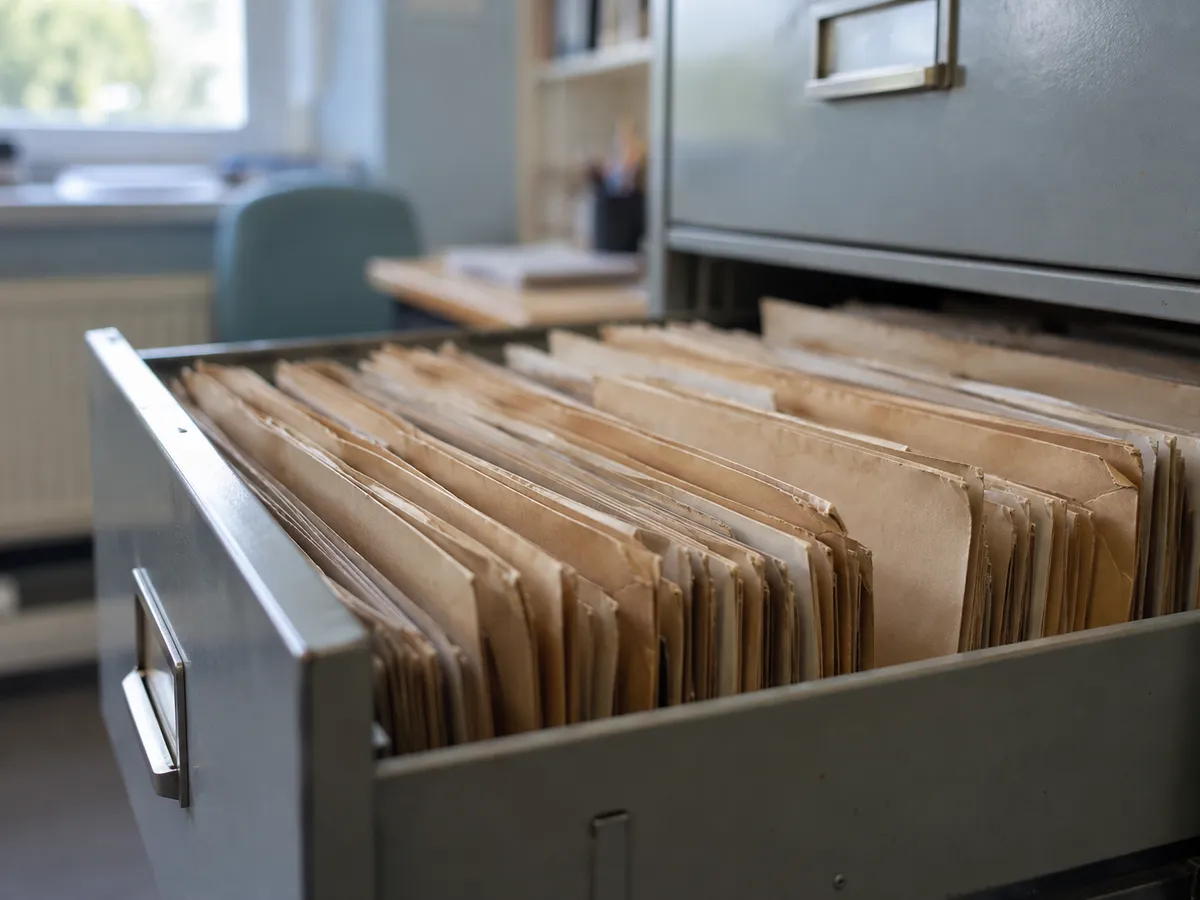
Older GP notes may still be on paper, in the envelope that moves with you.
Your GP record follows you. When you register with a new practice in England, the record is passed on electronically, and it is kept for as long as you are alive. That makes it the most complete long-term record most people have.
Hospital records stay with each trust. They do not follow you, and each trust applies the retention periods to its own records. Hospital letters sent to your GP may survive in your GP record even after the hospital’s own notes have been destroyed, which is one reason to check your GP record first.
Scotland, Wales and Northern Ireland
Scotland, Wales and Northern Ireland each have their own records management guidance for health and care records. The periods for most records are set by those codes rather than England’s, so check the relevant code or ask the organisation that treated you.
In practice, the question to ask is the same everywhere: “Do you still hold my records from this period, and if not, when were they destroyed?” Write to the health board in Scotland, the health board or trust in Wales, or the health and social care trust in Northern Ireland. GP records follow the same pattern as in England: they stay with your practice while you are registered and move with you when you change practice.
Private hospitals and clinics
Private hospitals, clinics and dentists keep their own records, separate from the NHS. They have the same duty to give you a copy when you ask, and they set retention periods for their own records. If you had an operation or scan privately, the NHS may only hold a letter about it, if anything.
Ask the private provider directly. If the clinic has closed or changed owners, the records should have been passed to another organisation; the provider’s successor, or the regulator that registered it, may be able to tell you where.
How to check whether an old record still exists
Ask the organisation that treated you with a subject access request. Say which period and department you are interested in. If the record has been destroyed, ask them to confirm that in writing; organisations usually keep a note of what was destroyed and when. Our subject access request guide for GP and hospital records explains how.
Your GP record is a good place to start. Letters from hospitals are often kept there, even when the hospital’s own file is gone. The NHS App shows your GP record in England; our guide to the NHS App GP record explains how to see older entries.
Records of someone who has died
GP records are kept for 10 years after a patient dies. Access to a deceased person’s records is covered by a separate law, the Access to Health Records Act 1990, which allows the person’s personal representative, and anyone with a claim arising from the death, to ask for them. It covers records made from 1 November 1991.
A personal representative is usually the executor named in the will, or the administrator of the estate. Expect to show proof, such as a grant of probate or letters of administration, along with a death certificate. Someone with a claim arising from the death may only receive the parts of the record that relate to the claim, and information the person asked to be kept private can be withheld.
For GP records, ask the practice the person was last registered with. If they were not registered when they died, or the practice has closed, the record may be held by the NHS records service for the area. In England this is Primary Care Support England.
What to collect while you can

Most people never need an old record, so there is no need to request everything. Think about the records that would be hard to replace:
| Record | Why it matters later |
|---|---|
| Operation notes and discharge summaries | Future surgeons and specialists ask what was done and when |
| Scans and their reports | A new scan is often compared with an older one |
| Childhood conditions and treatment | Hospital records from childhood can be destroyed in your mid-twenties |
| A parent’s major diagnoses | Family history can affect your own screening and care |
If one of these applies to you, ask for a copy now rather than when you need it.
Keep a permanent copy yourself
Retention periods are written for organisations, not for you. A copy you keep yourself lasts as long as you want it to. If an old record matters to you, such as the details of an operation, a childhood condition or a family history, get a copy while it still exists.
KeepMD is a personal health record app for keeping those copies together:
- Save documents. Pick a PDF you received or downloaded from the NHS App.
- Scan paper records. Photograph older paper letters and notes with your phone’s camera.
- Review before saving. KeepMD Vision reads the values on the page after you give consent, and you check every value before it is saved.
Your records stay encrypted on your phone. KeepMD does not connect to the NHS; you choose what to add. See medical document scanning for how it works.
If you are curious how this compares with the United States, where every state sets its own rules, see our US investigation into hospital record retention by state.