Hospital integration guide

Penn Medicine Penn Medicine · secure.mypennmedicine.org

Your Penn Medicine medical records

Use MyChart by myPennMedicine, contact the treating hospital's records office, get images through Ambra or the form, and check Lancaster General and Doylestown before organizing records in KeepMD.

Available to connect Connection status reviewed on

KeepMD is an independent personal health record app. It is not affiliated with, endorsed by, or operated by Penn Medicine or Epic Systems Corporation. MyChart® is a trademark of Epic Systems Corporation.

Portal MyChart by myPennMedicine secure.mypennmedicine.org
KeepMD connection Penn Medicine MyChart by myPennMedicine route for Penn Medicine, Chester County, Princeton and Doylestown patients; Lancaster General Health uses MyLGHealth, and each hospital lists its own records office
Records 215-662-3154 Medical Records Department, Hospital of the University of Pennsylvania

Start with the document you need

MyChart by myPennMedicine shows portions of your Penn Medicine record. Request a copy in the portal, or mail or fax the signed form to the hospital holding the records; each lists its own office. Lancaster General patients use MyLGHealth, and Doylestown records from before July 1, 2026 stay in older portals.

Which Penn Medicine records can you bring together?

Use these ten categories to check your connected records. What arrives depends on what the hospital has recorded and shares for your account and dates of care.

10 categories to check

10 types

Use this checklist for an Epic connection. Available content depends on your account; listing a category does not confirm that records in it have been imported.

  • Lab results
    Blood work and other laboratory results. Check the collection date, units, and reference range when comparing tests from different visits.
  • Vital signs
    Measurements such as blood pressure, pulse, height, and weight. Look at the visit date so an older measurement is not mistaken for a current one.
  • Medications (prescriptions)
    Prescription records may include current and past orders. A prescription entry does not establish what you take today; discuss discrepancies with your care team.
  • Allergies and intolerances
    Recorded allergies, intolerances, and reactions. An empty list does not confirm that you have no allergies; compare it with information you have given your clinician.
  • Immunizations
    Vaccinations documented in the chart. Doses given at a pharmacy, school, or another health system may need to be obtained from that source.
  • Health conditions and problems
    Diagnoses and entries on the problem list. Some entries describe past care; ask the treating team about an unfamiliar or incorrect entry.
  • Procedures
    Documented procedures and treatment history. For the details of an operation, look for the operative report as well as the procedure entry.
  • Visits and encounters
    Office visits, emergency visits, and hospital stays. Compare the facility and dates with your own appointment or discharge paperwork.
  • Clinical documents and notes
    Released clinical notes, visit summaries, and other documents. Availability can differ by document and date; request a missing note by visit and clinician.
  • Diagnostic reports
    Written findings from imaging or other diagnostic tests. The report explains the findings; the actual scan images may follow a separate download or request process.

Not yet verified

1 type

These may exist in the portal, but KeepMD has not verified their availability through this connection.

  • Categories available in your account
    MyChart by myPennMedicine coverage depends on the patient, encounter and permissions. Compare each category with the portal; this guide does not certify every category as imported.

Usually a separate request

2 types

Records Penn Medicine typically releases through its medical-records process, not through the patient-access connection.

  • Images and reports
    The report and the image files are different records. Confirm the imaging location and study date before requesting a copy.
  • Complete chart or certified documents
    Use the formal request route for the correct custodian; a portal view can be partial.

The Penn Medicine connection in seven steps

Illustrative walkthrough: find Penn Medicine, confirm the MyChart by myPennMedicine portal, and review access before sharing information. The screens and counts are examples, not a record of an import from this hospital.

  1. Step 1 of 7

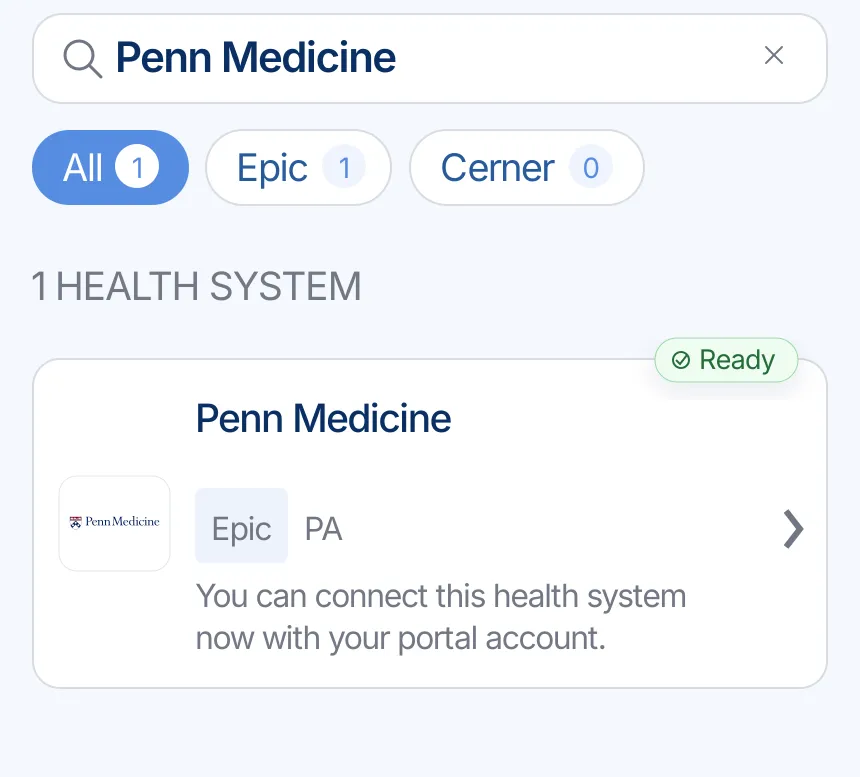
    Find Penn Medicine

    Search for Penn Medicine in KeepMD. Confirm the portal is secure.mypennmedicine.org and matches the location that treated you.

    Illustrative example: KeepMD search results showing Penn Medicine ready to connect
    Example of provider search in KeepMD.
  2. Step 2 of 7

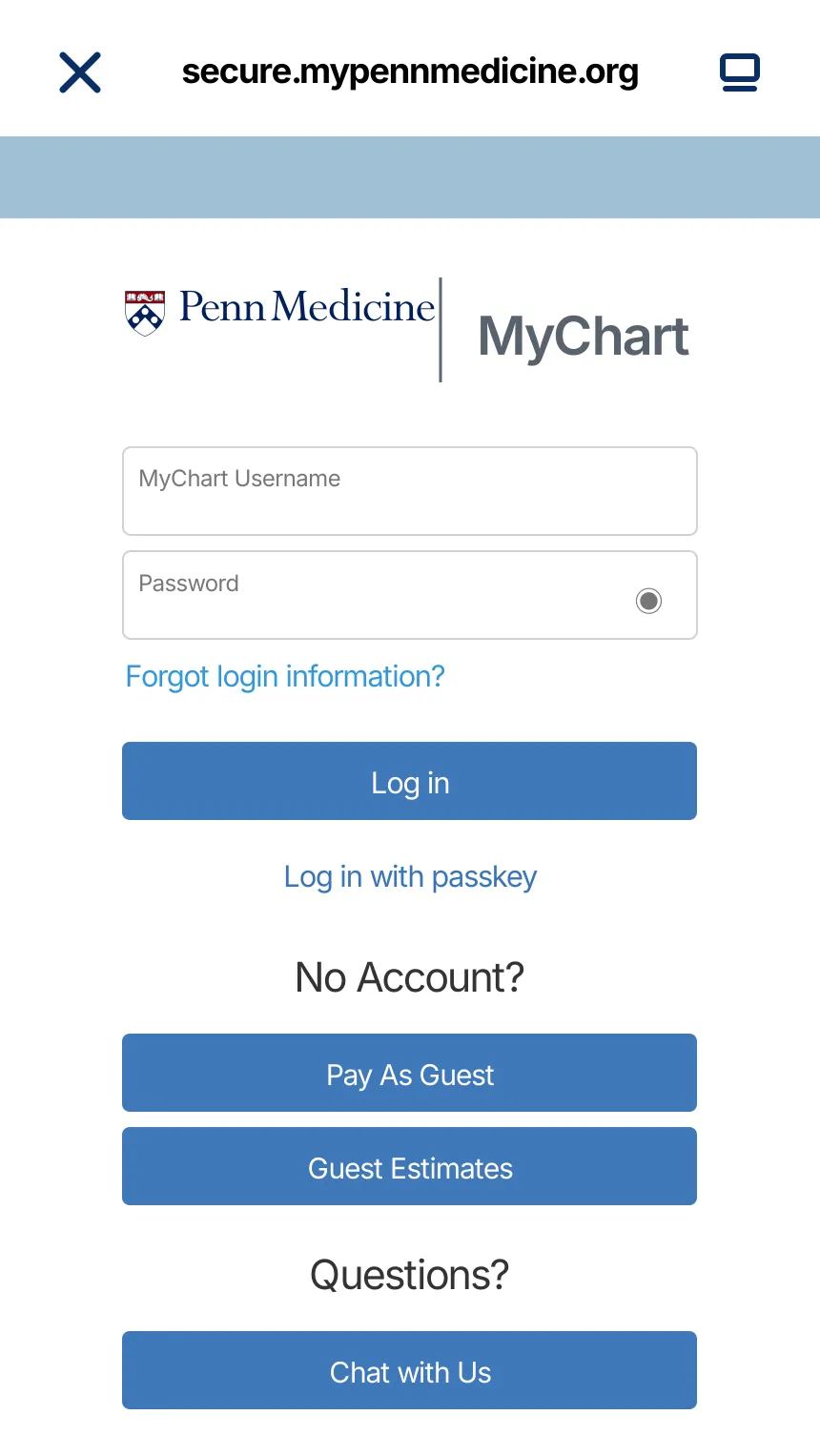
    Continue to MyChart by myPennMedicine

    KeepMD opens the provider-owned sign-in page. Enter credentials there; KeepMD does not receive or store your password.

    Illustrative example: MyChart by myPennMedicine sign-in handoff for the Penn Medicine connection
    Secure handoff to MyChart by myPennMedicine.
  3. Step 3 of 7

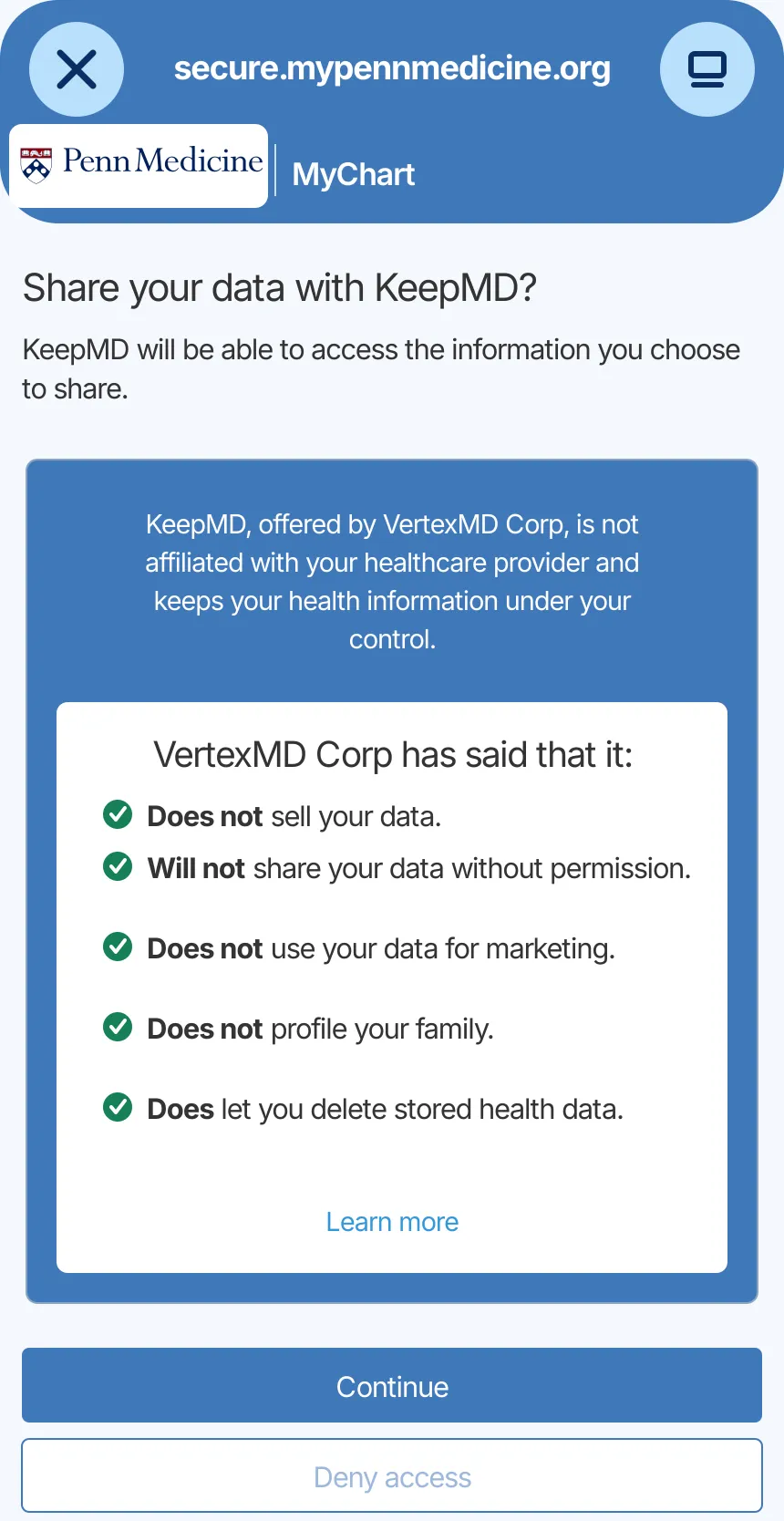
    Review access

    Review the information the portal can share and decide whether to authorize the connection.

    Illustrative example: KeepMD data-sharing consent screen for the Penn Medicine connection
    Access review for the provider connection.
  4. Step 4 of 7

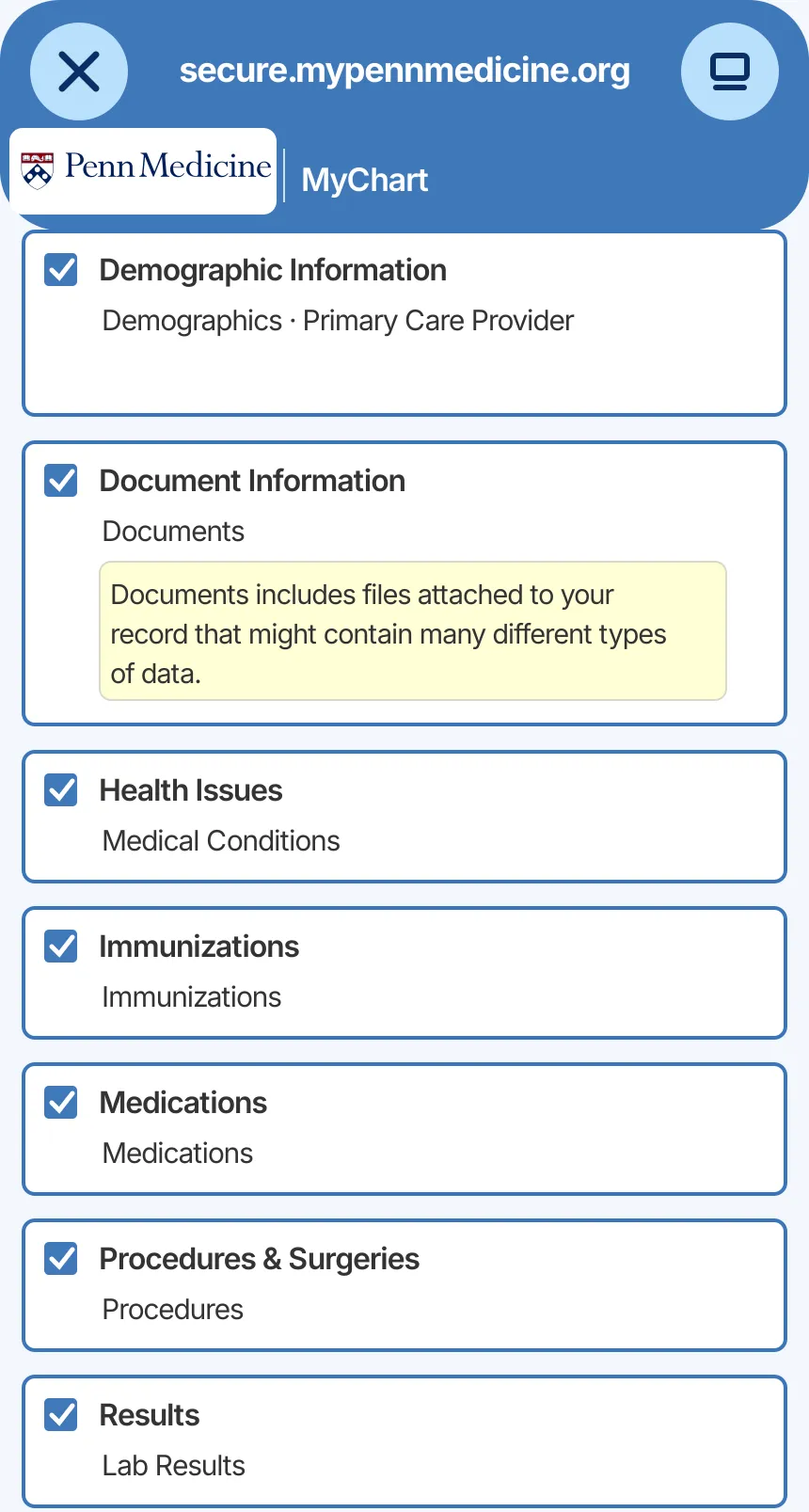
    Choose record categories

    Select the information you want to organize. Actual availability depends on your account.

    Illustrative example: Epic MyChart record categories available to choose for the Penn Medicine connection
    Health-information categories selected for import.
  5. Step 5 of 7

    Import available records

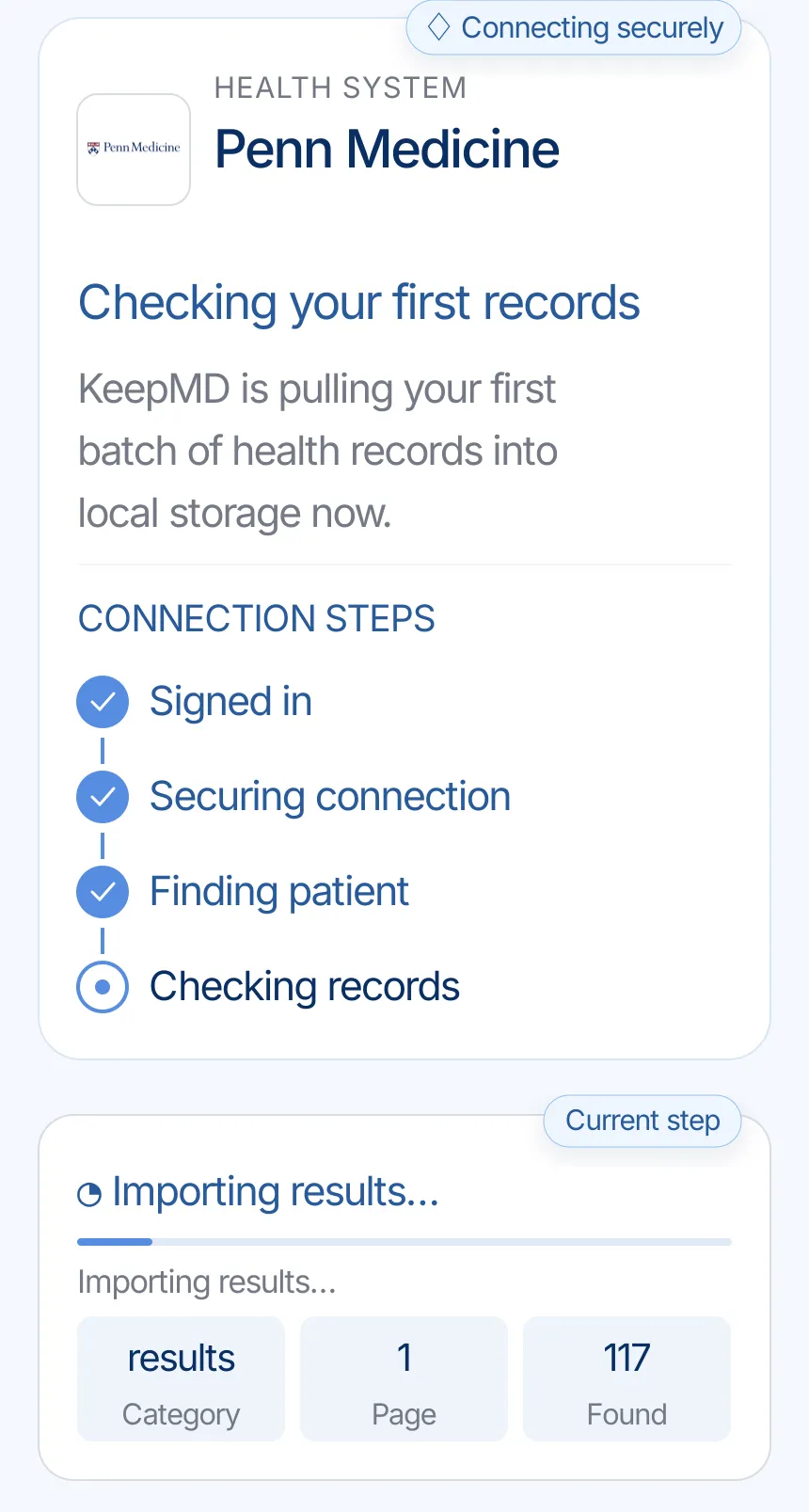
    KeepMD secures the connection and checks the information the provider makes available.

    Illustrative example: KeepMD checking the first records from Penn Medicine
    KeepMD checking available records.
  6. Step 6 of 7

    Review organized records

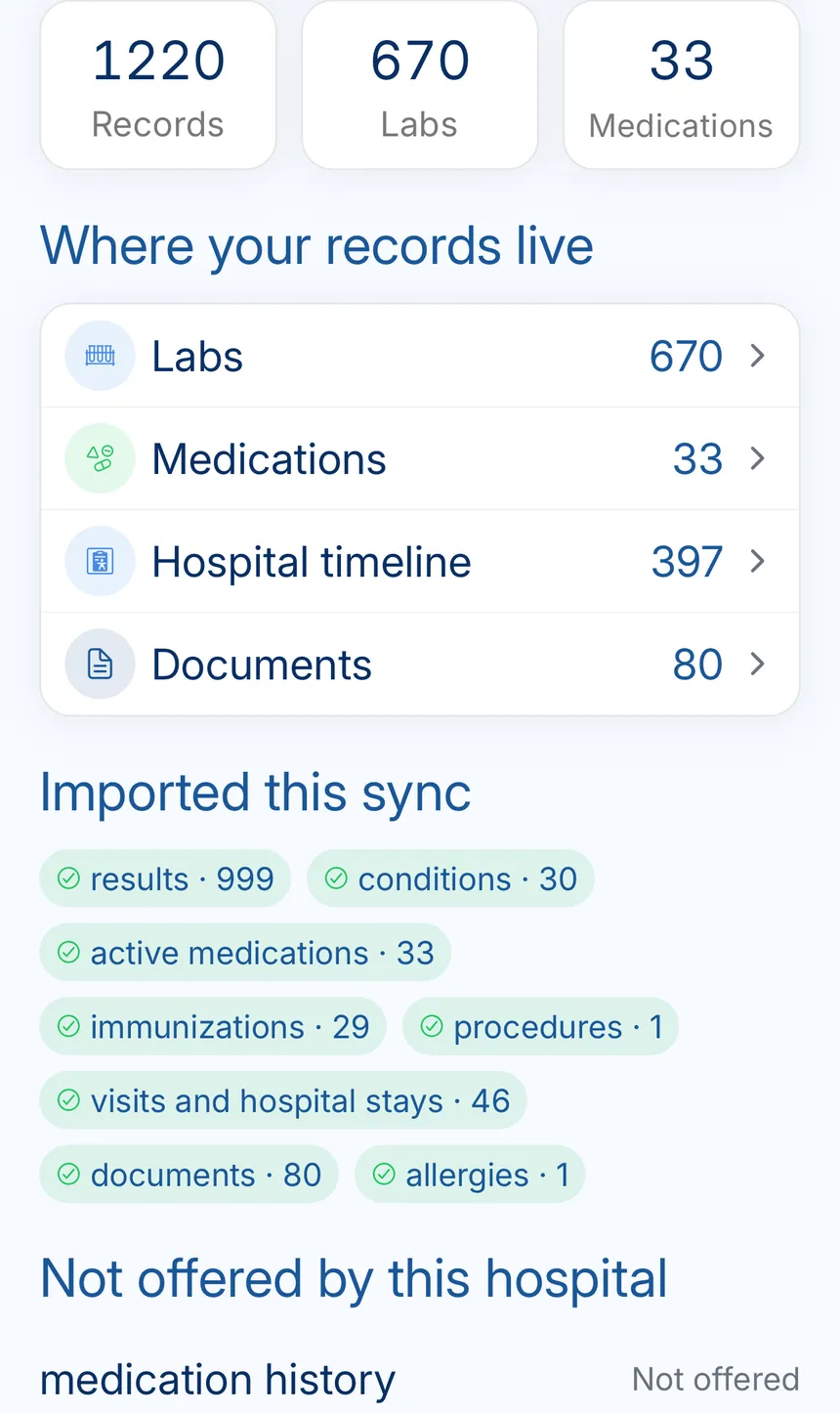
    KeepMD groups what the connection returns. Categories and totals can vary.

    Illustrative example: KeepMD record summary showing organized labs, medications, timeline events, and documents
    Provider records organized in KeepMD.
  7. Step 7 of 7

    See the connection summary

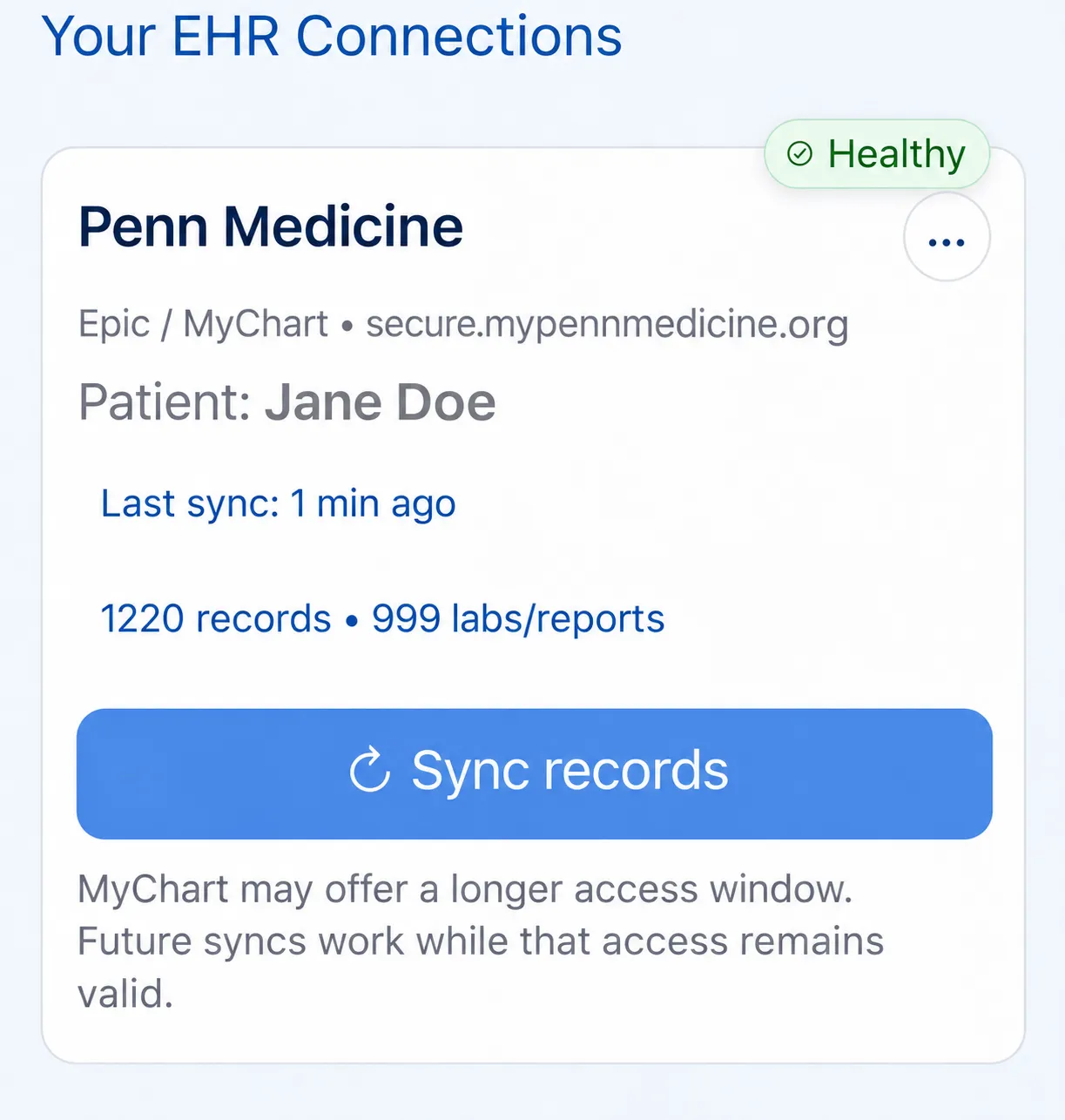
    The summary keeps the provider, last update, and organized categories together.

    Illustrative example: healthy Penn Medicine connection in KeepMD with a recent sync and Sync records control
    Penn Medicine connection summary in KeepMD.

Penn Medicine: access and requests

Everything the connection does not cover: identifying the right organization, portal downloads, formal requests, privacy, and the post-import check.

Identify your portal and treating location

Health system
Penn Medicine
Patient portal
Penn Medicine (secure.mypennmedicine.org)
Platform
Epic MyChart
Also appears as
  • Penn Medicine
  • MyPennMedicine
  • myPennMedicine
  • University of Pennsylvania Health System
  • Hospital of the University of Pennsylvania
  • Penn Presbyterian Medical Center
  • Pennsylvania Hospital
  • Chester County Hospital
  • Princeton Medical Center
  • Penn Medicine Doylestown Health

MyChart by myPennMedicine is the patient portal for Penn Medicine, Chester County Hospital and Princeton Medical Center patients and, since July 1, 2026, Penn Medicine Doylestown Health. It shows portions of your record. In KeepMD, search for Penn Medicine and confirm the sign-in page is MyChart by myPennMedicine before authorizing. Lancaster General Health patients use MyLGHealth, a separate portal with its own KeepMD listing. Penn State Health and Penn Highlands Healthcare are separate health systems with their own portals, so check the name on your paperwork.

Review and download your documents

Penn Medicine's records page says you can request a copy in the portal and download a PDF for yourself or another provider. To send records to another provider or anyone else, mail or fax the Authorization for Disclosure of Health Information to the hospital where you want to request records, and ask that office whether a Spanish version is available. The form says Penn Medicine tries to respond within 30 days for records on site and 60 days otherwise, with up to 30 more on written notice. Copies may carry fees under federal and state rules; the form says radiology images and reports are free to patients.

Request the right records

Penn Medicine lists a records office for each hospital: Hospital of the University of Pennsylvania, 215-662-3154, fax 215-662-6300; Penn Presbyterian Medical Center, 215-662-8959, fax 215-243-8758; Pennsylvania Hospital, 215-829-3931, fax 215-829-3027; Chester County Hospital, 610-431-5678, fax 610-431-5025; Princeton Medical Center, 609-853-7050, fax 609-853-7051; Lancaster General Health, 717-544-5911, fax 717-544-5914. The form asks that ambulatory or office-visit requests go to the individual physician's office. A parent or legal guardian generally signs for a minor; for a deceased patient, the estate or, without an executor, the next of kin responsible for the remains. Penn Medicine may request proof. KeepMD does not decide who may access a Penn Medicine chart.

Records 215-662-3154 Medical Records Department, Hospital of the University of Pennsylvania

Review access before authorizing

Authorize through Penn Medicine's official portal and confirm the patient. Follow the hospital's proxy permissions when helping a relative.

Keep passwords and sign-in codes private. To stop future app access, check the portal's connected-app controls. Removing permission does not automatically delete files already downloaded or shared. KeepMD is independent of Penn Medicine and Epic. The screens are examples with synthetic values, not evidence of a hospital-specific import.

Review imported records and permissions

After the first import, compare one Penn Medicine visit, its date and the record categories with MyChart by myPennMedicine. Keep MyLGHealth, Doylestown's older portals and independent practices on a separate checklist: PentaHealth says it remains independent of Penn, and Penn Medicine's FAQ names six Doylestown-area independent practices that began using the portal on July 1, 2026, so ask those offices about their records. A missing document can reflect portal scope, the Doylestown date split, a different office or an unfinished request. Describe the gap to the records office without sharing your password. Amendments must be requested in writing, signed, with reasons; a second KeepMD sync cannot change the source record.

Known Penn Medicine quirks worth checking

The visit is missing

Doylestown Health records split by date. Visits on or after July 1, 2026 appear in MyChart by myPennMedicine. Earlier records do not; they stay read-only in MyHealthDoylestown for hospital and ER visits and in the Physician Practices and Urgent Care portal for office and urgent care visits. For earlier hospital records, call 267-885-1599, 8 a.m. to 5 p.m., Monday through Friday; for earlier office records, call your doctor's office or Penn Urgent Care Doylestown. Penn Medicine's page for outside practices lists Doylestown Hospital's Health Information Services Department at 215-345-2314, fax 215-489-7235; the authorization form's checklist does not name Doylestown, so ask which form to use.


You need original images

The authorization form has separate Radiology Reports and Radiology Images boxes and offers US Mail (Paper), CD or Email delivery; it warns that CDs of images are not encrypted. The portal FAQ also describes Ambra, reached through MyChart, for downloading and sharing cardiology and radiology images done at Penn Medicine or uploading outside imaging, which can take up to 72 hours to review. Ambra support is 888-315-0790. That FAQ belongs to MyChart by myPennMedicine, so Lancaster General patients should ask Medical Record Services. A report visible in the portal does not mean the image files arrive in KeepMD; give the receiving clinician the study date.

FAQ

Penn Medicine records questions

Sources